[25] DISSECTING THE MOLECULAR BASIS OF POTENT HBF INDUCTION BY BMS-986470: A MECHANISTIC STUDY OF ZBTB7A/WIZ DUAL DEGRADATION
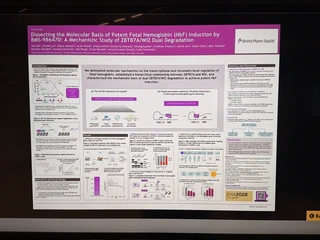 Molecular Basis of HbF Induction by BMS-986470
Sickle cell disease (SCD) remains a major global health burden with limited therapeutic options. Reactivation of fetal hemoglobin (HbF) is clinically validated to mitigate disease severity. BMS-986470 is a first-in-class, orally bioavailable cereblon E3 ligase modulator (CELMoD™) that selectively degrades ZBTB7A and WIZ—two transcriptional repressors of the γ-globin genes previously considered undruggable—resulting in robust HbF induction and an erythroid program shift from adult β-globin toward fetal γ-globin expression. BMS-986470 is currently under clinical investigation (NCT06481306).
Aims
We delineated the molecular mechanisms underlying BMS-986470–mediated HbF induction, with a focus on developing a better understanding of the contributions of ZBTB7A and WIZ degradation.
Results
Genome-wide CRISPR screen. To compare the HbF-repressing capacity of ZBTB7A and WIZ, we performed an unbiased, phenotypic, genome-wide CRISPR-Cas9 screen in HUDEP-2 cells. Differential sgRNA enrichment/depletion between HbF-high and HbF-low populations provided a quantitative readout per gene. The screen recovered established HbF repressors (ZBTB7A, BCL11A, ZNF410, WIZ, CHD4), validating the approach. Notably, ZBTB7A-targeting sgRNAs were more enriched in HbF-high cells than WIZ-targeting sgRNAs, indicating stronger repression by ZBTB7A. Intriguingly, HBB emerged as the top-ranked HbF repressor genome-wide, consistent with reports that HBB promoter disruption facilitates fetal globin reactivation.
CRISPR knockout lines. We generated single and dual knockouts (KOs) of ZBTB7A/WIZ in HUDEP-2 cells. Immunoblotting showed greater γ-globin (HBG1/2) induction in ZBTB7A KO versus WIZ KO cells. The double KO further increased HBG1/2 and HbF tetramers while reducing adult β-globin (HBB) compared with either single KO, supporting a dominant role for ZBTB7A in fetal globin silencing.
Chromatin architecture by Micro-C. BMS-986470 induced a pronounced looping switch—reduced LCR–HBB contacts and increased LCR–HBG contacts—at the β-globin locus. Micro-C in KO lines showed that both ZBTB7A and WIZ loss disrupt LCR–HBB contacts; however, ZBTB7A KO produced a substantially stronger gain in LCR–HBG looping than WIZ KO. These findings implicate ZBTB7A as the stronger mediator of LCR-driven promoter competition and explain why dual degradation by BMS-986470 leads to a robust adult-to-fetal globin chromatin and transcriptional switch.
Summary
We delineated the transcriptional and chromatin-level mechanisms of HbF regulation and established a functional hierarchy between ZBTB7A and WIZ. These findings provide mechanistic insights into the therapeutic potential of BMS-986470 for SCD treatment.
This work was presented at the European Hematology Association (EHA) Annual Congress 2026 in Stockholm, Sweden (June 2026).